By Mike Napolitano
For more than nine years now, the United States Military, in coordination with NATO forces, has been engaging in combat operations in Afghanistan. While supporters of the war state that controlling and stabilizing Afghanistan is vital to the security of the United States and its allies, opponents of the war state that the persistent presence of US military forces is actually causing a destabilization of the country. Additionally, US intervention is being scrutinized for the negative effects it is having on the social constructs in Afghanistan. This, on top of an unstable Afghani government, poses a great logistical and tactical predicament to military and political operations in the country.
Afghanistan is an interesting political anomaly. As a modern state, Afghanistan is not defined as a nation state because there is not a single dominating ethnic group that defines the country. Unlike other Central Asian countries such as Tajikistan and Uzbekistan where the prominent ethnic groups are Tajiks and Uzbeks respectively, Afghanistan is compromised of various different groups including Pashtuns, Tajiks, Uzbeks, and Hazaras (Maley). Because of these diverse groups who carry varied customs and dialects, finding a common cultural thread amongst Afghanis is nearly impossible. This assessment helps shed light on the tumultuous political atmosphere in Afghanistan.
Although Afghanis are more likely to associate themselves with individuals who share similar ethnic, tribal, and sectarian characteristics, an overwhelming majority of Afghanis are Muslim (Maley). Many Afghanis who become disgruntled with the political situation in the country are much more prone to associate themselves with an Islamist organization such as the Taliban or the Mujahedeen. This trend is seen, “even among disaffected Afghans most likely to support the Taliban,” that, “there was no evidence that ethnicity was a major worry” (Jones 12). It is clear that the Taliban, as a regional organization in Afghanistan and Pakistan, is more concerned with expelling those that they see as intruders on their territory, seen in their fighting against the Soviets in the 1980s and the Americans for the past eight years.
As the Taliban is such a rooted enemy, especially near the Pakistani border, the US military is having difficulty dealing with the insurgents. Mao Zedong once said that, “guerrillas are like fish which swim in the sea,” and that, “the sea is the civilian population, which provides the guerrillas with the support they need to survive” (Robinson 4). The difficulty then for those fighting militants is that, “counterinsurgency theory demands that the state catch the fish from the sea… to separate the insurgents from the population,” which is usually done, unfortunately, in brutal ways (Robinson 4).
Undoubtedly, the tactics used to pin-point and extricate suspected insurgents needs to be reconsidered. Currently, it seems that the course of action being taken by the US military is causing Pashtun villagers in Afghanistan to begin to, “lose faith in the American project” (Gopal 12). The trend in many villages in Afghanistan is that the villagers become victims of target bombings – where the US Military is attempting to ‘fish out’ suspected insurgents by bombing specific locations – and become supporters of the Taliban, their most convenient alternative to turn to. Instead of the use of violent means to try and ‘fish out’ suspected insurgents, many are saying that the, “best way to keep Americans safe from terrorism is through effective intelligence, expert police work and judicious homeland defense,” and that, “these practical measures cost far less than war and occupation in Muslim lands, which arouse hatred of the United States—and give strength to Islamist extremists” (vanden Heuvel 3).
The difficulty of winning the ‘hearts and minds’ of Afghanis is an interesting problem for the US government. On the one hand, “the paradox of military engagement in such a conflict is that the more you fight the more you lose” (Schell 18), where as, “the paradox of political engagement is that the more you rule the weaker the native component of the government becomes, and the more likely it is to collapse when you leave” (Schell 18). With this analogy, the costs of the war on the US efforts are clearer. While prolonged military engagement may result in relative stability and security, it also causes more casualties, more collateral damage to infrastructure, and more discontent among the citizens of both in the United States and Afghanistan. Furthermore, the longer the US remains in Afghanistan, the weaker the Afghani government will become as it will begin to rely more heavily on US support and intervention that, eventually, it will cease to function and collapse.
It is imperative for the United States government to reconsider their course of action in Afghanistan. Because President Obama has recently recommitted to US military operations, alternative theories must be present to, at the very least, combat the persistent use of violent military force. Some scholars believe that the best course of action is to involve Afghanistan’s neighbors by investing in a security initiative in the region. This can take the form of, “a major United Nations diplomatic initiative designed to get Afghanistan’s regional neighbors to join in setting a disengagement timetable and to share responsibility for preventing a Taliban return to power in Kabul” (Harrison 6). This type of solution cannot be attempted unless the US government seeks a major diplomatic initiative in Central Asia.
Afghanistan, however, cannot partake in multilateral talks with its neighbors if its own government is unstable. According to some scholars, “the collapse of governance in Afghanistan was a precondition for the onset of the insurgency” (Jones 19). This collapse of governance is rooted in the poor political management of Hamid Karzai, the Afghani president. The key to regain governance in Afghanistan is to reestablish the legitimacy of the government amongst the citizenry. It is difficult, however, for the US and Afghani governments to build relationships with Afghanis when the government isn’t functioning properly and botched military strikes are harming the civilian population. Admiral Michael Mullen, Chairman of the US Joint Chiefs of Staff, wrote in Joint Forces Quarterly that, “For all the time we spend thinking about how we communicate our actions, we are failing to actually build relationships and convince the majority Afghans not to hate us. The Taliban, on the other hand, are doing pretty well” (Xinhua News Agency). This highlights the issue quite clearly: the Taliban is taking advantage of situations created by the US and allied forces which is hurting the political and military stability of the country.
There have been efforts by the US government to set up programs and initiatives to provide social and economic support to Afghanistan. These programs, however, have been mostly unsuccessful because of mismanagement by the Afghani government. Often, projects are planned by the US government and then given to the Afghani government to appropriate funds or find a local firm to handle the project (Roston 13). The issue, however, is that President Karzai often gives projects to unqualified or corrupt individuals (ibid). In one instance, Karzai gave a $360 million security and transportation contract to his cousins who have, “no known trucking experience, and little security experience to speak of,” and who have been charged with smuggling heroin into the US during the 1990s (Roston 16). It is unfortunate that the US government does not look further into the ethical and legal shortcomings of the Karzai administration but, until they do, US funded programs are not going to function properly and the Afghani people are going to continue to suffer.
The Afghani government has so many issues to solve that it is difficult to determine where to begin. As Afghanistan is in a state of war, resolution of certain issues will take significant political, diplomatic, and social will. Additionally, the Afghani government is at a crucial juncture as it is nearing the point where it will be unable to govern because it has become too heavily reliant on US support. Beyond that, the United States has to reevaluate their commitment to Afghanistan to try and decide how long is too long to invest resources, money, and human life in the country. The US government must realize, “that the American public will not support war without end, which means [the US military will have] to leave one day” (Schell 18). The reality is that the current strategy in Afghanistan is not working and it is failing at a massive human cost. The tactics the military is using either needs to be completely reconsidered or the US needs to withdraw from Afghanistan and let Afghanis resolve their own political differences.
Works Cited
-Chouvy, Pierre-Arnaud, and Laurent R. Laniel. "Agricultural Drug Economies: Cause or Alternative to Intra-state Conflicts?" Criminal Law and Social Change 48 (2007): 133-50. ProQuest. Web. 2 Apr. 2010.
-Filkins, Dexter. "Despite Doubt, Karzai Brother Retains Power." The New York Times 31 Mar. 2010, Late Edition ed., Main Section sec.: A1+. Print.
-Gopal, Anand. "America's Secret Afghan Prisons." The Nation 15 Feb. 2010: 12-16. Print.
-Harrison, Selig S. "How to Exit Afghanistan." The Nation 11/18 Jan. 2010: 6-7. Print.
-Jones, Seth G. "The Rise of Afghanistan's Insurgency State Failure and Jihad." Internaitonal Security 32.4 (Spring 2008): 6-39. Project Muse. Web. 2 Apr. 2010.
-Maley, William. "Afghanistan." Oxford Companion to the Politics of the World. 2nd ed. OUP, 2001. Web. 2 Apr. 2010.
-"Military chief: U.S. public diplomacy in Afghanistan flawed." Xinhua News Agency 28 Aug. 2009. Custom Newspapers. Web. 19 Apr. 2010.
-Robinson, Paul. "Soviet Hearts-and-Minds Operations in Afghanistan." The Historian (March 1, 2010). EBSCO. Web. 2 Apr. 2010.
-Roston, Aram. "How the US Funds the Taliban." The Nation 30 Nov. 2009: 12-16. Print.
-Schell, Jonathan. "The Fifty-Year War." The Nation 30 Nov. 2009: 18-22. Print.
-Van Ham, Peter, and Jorrit Kamminga. "Poppies for Peace: Reforming Afghanistan's Opium Industry." The Washington Quarterly 30.1 (2006): 69-81. Project Muse. Web. 2 Apr. 2010.
-Vanden Heuvel, Katrina. "Obama's War." Editorial. The Nation 21/28 Dec. 2009: 4-5. Print.
Showing posts with label mike. Show all posts
Showing posts with label mike. Show all posts
29 April 2011

03 April 2010
Short Story: Winter Walking
By: Mike Napolitano
“Can you imagine what it’s like under the ice right now?” I asked Anthony.
“It must be an entirely different world...suspended like that under ice.” Anthony seemed too lost in his own thoughts to continue his discourse on the pond. Although it wasn’t entirely frozen over, the pond had a thick layer of ice over the most of it. Anthony was kneeling at the edge of the pond and continued to stare directly into the center of it. He has a capability of appreciating nature that I could never match, and for that, I admire him. I could only imagine what he was thinking of. “You ready man?”
We turned and continued to move through the forest. I glanced over at the Hudson. All the trees were bare, allowing for a clear view of the river. I suppose the beauty of winter is that everything is in suspense and seems to move slowly. As we walked on, I continued to glance at the river watching the ice drift along with the current. The snow in front of us was completely untouched. With every step we took, we were creating a new mark upon the earth. I was so tranquil; it was almost as if every step I took away from Marist was a step away from all the homework, problems, and drama of student life.
I always looked forward to the next opportunity I had to walk through the woods with Anthony as my guide. He was the one who first showed me the splendor of a simple hike, to be able to walk through the plants until you felt a relaxing solidarity with nature. Anthony always told me about his idea of ‘oneness,’ which he said to be the feeling of being part of the whole, to feel compassion for everything around you. To me, it seemed like Anthony drew his entire spiritual being from his experiences in nature and I wanted to understand that.
As we meandered through the woods, we approached a ridge that I thought was going to lead to a severe drop but when we reached the edge of the hill, I realized that it wasn’t at all steep. Amazingly enough, the hill led down to a gully where a small creek appeared to have formed. I had never seen anything like it. The water was flowing between trees, through roots, around trunks, past piles of sticks, mounds of dirt. It was as if nature intended to connect all the water together by using the landscape as a path; the bare, vertical trees provided a labyrinth-like grid for the water to flow through.
Anthony and I approached the creek. It must have stretched about a quarter mile. The creek was odd, though, as it was only a few feet wide in spots while in others, it opened up to around ten feet. Naturally, Anthony and I went straight for the edge of the creek at the most narrow section as our acute sense of curiosity subliminally told us to. Approaching the creek, I glanced at Anthony and noticed a whimsical expression of glee on his face; he was evidently overjoyed at our discovery.
We walked between the trees, climbed over the roots, and hopped between the banks. After a few minutes, we both had our share of exploring the new terrain. I looked at Anthony and met his eyes behind his thick, unkempt beard. I could tell he knew what he wanted to do because, after all, nature is his forte. He smiled at me and sat, knees at the chest, on a downed branch. Following his lead, I kneeled next to a tree and used it as a back. Anthony had told me about his experiences meditating in the woods and I could tell that was what was on his mind.
Following his lead, I just sat. I closed my eyes and listened to the water capriciously flow through the roots of the trees. I was rapidly releasing all the stress that I had built up from earlier in the week. A part of me felt the flow of the water moving through my body, almost as if it was purifying me. I was meditating. I felt my mind becoming lighter than my body as if my troubled thoughts were escaping the confines of my skull. A surge of my spirit rushed through me, I felt revitalized.
I opened my eyes. The world was so very vibrant. Sounds were clearer, the water looked crisper, and the cool breeze felt so embracing around my bare cheeks. I reached down to touch the water. Letting it flow through my fingers, it felt as though the water was at its most basic form. Just touching the water was so incredibly refreshing. I took a deep breath allowing for the cold winter air to fill up my lungs. Never before had I felt so energized by a lungful of air. Through my sunglasses the snow was lustrous, the water was glistening. The world seemed to gleam before my eyes.
As I rose up from my crouching position, I noticed Anthony was also rousing from his rumination. There seemed to be an unsaid mutual agreement between us and we simultaneously turned back. It was the return trip back to the ‘real world.’ It was a very odd experience walking back. It seemed to take four times the amount of time to get to the creek as it took us to walk back. Uncharacteristic for Anthony and me, we didn’t talk much as we walked.
Much to our style we took a different route back. As we were crossing through a small field, we suddenly noticed something interesting above us. On the first branch of a nearby tree, we spotted a hawk. We found ourselves taken back by the new scenario that nature had given us. “What should we do?” I asked Anthony.
“I don’t know man…I’ve never been this close to a hawk. Let’s just wait for a few minutes.” So we stood in the field and watched this hawk watch us. The hawk was like no other creature I had ever seen in person. It had a large roundish torso that was mostly decorated with opal white feathers and a few other grey feathers mixed around the sides. Its eyes were particularly striking. They were brilliantly astute and it was evident that it could scan every inch of the ground even when flying above the trees.
It turned and spotted us. Anthony and I stared at this hawk staring back at us. The bird did not seem threatened by its human intruders; it was as if it was studying us as we were studying it. It seemed, in that one instance, a bird and two mammals shared a field, and nothing more happened. After the hawk was content, it turned and flew off in another direction. Watching the hawk fly away was a sight to behold. It happened so quickly but I won’t soon forget the astounding wing span it had. I couldn’t get past the fact that I was within twenty feet of a hawk.
Without a hawk to maintain our attention, we moved on towards Marist. Once we came within a few hundred feet of the end of the arboretum, we were greeted by a paved drive meant to allow access to St. Ann’s Hermitage. As the warm scent of brush left me, I was greeted by the dry, pungent scent of wet asphalt. We were still in the cover of the trees, but we were now on pavement. A minute later, the cover of the trees left us and I stared southward upon Fontaine, Dyson, Gartland, and the rest of the Marist campus.
The sight of the black pavement and its abrasive road paint assaulted my eyes almost as if it was a foreign design I had never seen before. The lack of tree cover forced all the unnatural colors of the campus back into my retinas. The noise of people and cars met my ears once again and the hustle and bustle of daily life was back to command my attention. My eyes begrudgingly adjusted, I returned home and started my homework.
“Can you imagine what it’s like under the ice right now?” I asked Anthony.
“It must be an entirely different world...suspended like that under ice.” Anthony seemed too lost in his own thoughts to continue his discourse on the pond. Although it wasn’t entirely frozen over, the pond had a thick layer of ice over the most of it. Anthony was kneeling at the edge of the pond and continued to stare directly into the center of it. He has a capability of appreciating nature that I could never match, and for that, I admire him. I could only imagine what he was thinking of. “You ready man?”
We turned and continued to move through the forest. I glanced over at the Hudson. All the trees were bare, allowing for a clear view of the river. I suppose the beauty of winter is that everything is in suspense and seems to move slowly. As we walked on, I continued to glance at the river watching the ice drift along with the current. The snow in front of us was completely untouched. With every step we took, we were creating a new mark upon the earth. I was so tranquil; it was almost as if every step I took away from Marist was a step away from all the homework, problems, and drama of student life.
I always looked forward to the next opportunity I had to walk through the woods with Anthony as my guide. He was the one who first showed me the splendor of a simple hike, to be able to walk through the plants until you felt a relaxing solidarity with nature. Anthony always told me about his idea of ‘oneness,’ which he said to be the feeling of being part of the whole, to feel compassion for everything around you. To me, it seemed like Anthony drew his entire spiritual being from his experiences in nature and I wanted to understand that.
As we meandered through the woods, we approached a ridge that I thought was going to lead to a severe drop but when we reached the edge of the hill, I realized that it wasn’t at all steep. Amazingly enough, the hill led down to a gully where a small creek appeared to have formed. I had never seen anything like it. The water was flowing between trees, through roots, around trunks, past piles of sticks, mounds of dirt. It was as if nature intended to connect all the water together by using the landscape as a path; the bare, vertical trees provided a labyrinth-like grid for the water to flow through.
Anthony and I approached the creek. It must have stretched about a quarter mile. The creek was odd, though, as it was only a few feet wide in spots while in others, it opened up to around ten feet. Naturally, Anthony and I went straight for the edge of the creek at the most narrow section as our acute sense of curiosity subliminally told us to. Approaching the creek, I glanced at Anthony and noticed a whimsical expression of glee on his face; he was evidently overjoyed at our discovery.
We walked between the trees, climbed over the roots, and hopped between the banks. After a few minutes, we both had our share of exploring the new terrain. I looked at Anthony and met his eyes behind his thick, unkempt beard. I could tell he knew what he wanted to do because, after all, nature is his forte. He smiled at me and sat, knees at the chest, on a downed branch. Following his lead, I kneeled next to a tree and used it as a back. Anthony had told me about his experiences meditating in the woods and I could tell that was what was on his mind.
Following his lead, I just sat. I closed my eyes and listened to the water capriciously flow through the roots of the trees. I was rapidly releasing all the stress that I had built up from earlier in the week. A part of me felt the flow of the water moving through my body, almost as if it was purifying me. I was meditating. I felt my mind becoming lighter than my body as if my troubled thoughts were escaping the confines of my skull. A surge of my spirit rushed through me, I felt revitalized.
I opened my eyes. The world was so very vibrant. Sounds were clearer, the water looked crisper, and the cool breeze felt so embracing around my bare cheeks. I reached down to touch the water. Letting it flow through my fingers, it felt as though the water was at its most basic form. Just touching the water was so incredibly refreshing. I took a deep breath allowing for the cold winter air to fill up my lungs. Never before had I felt so energized by a lungful of air. Through my sunglasses the snow was lustrous, the water was glistening. The world seemed to gleam before my eyes.
As I rose up from my crouching position, I noticed Anthony was also rousing from his rumination. There seemed to be an unsaid mutual agreement between us and we simultaneously turned back. It was the return trip back to the ‘real world.’ It was a very odd experience walking back. It seemed to take four times the amount of time to get to the creek as it took us to walk back. Uncharacteristic for Anthony and me, we didn’t talk much as we walked.
Much to our style we took a different route back. As we were crossing through a small field, we suddenly noticed something interesting above us. On the first branch of a nearby tree, we spotted a hawk. We found ourselves taken back by the new scenario that nature had given us. “What should we do?” I asked Anthony.
“I don’t know man…I’ve never been this close to a hawk. Let’s just wait for a few minutes.” So we stood in the field and watched this hawk watch us. The hawk was like no other creature I had ever seen in person. It had a large roundish torso that was mostly decorated with opal white feathers and a few other grey feathers mixed around the sides. Its eyes were particularly striking. They were brilliantly astute and it was evident that it could scan every inch of the ground even when flying above the trees.
It turned and spotted us. Anthony and I stared at this hawk staring back at us. The bird did not seem threatened by its human intruders; it was as if it was studying us as we were studying it. It seemed, in that one instance, a bird and two mammals shared a field, and nothing more happened. After the hawk was content, it turned and flew off in another direction. Watching the hawk fly away was a sight to behold. It happened so quickly but I won’t soon forget the astounding wing span it had. I couldn’t get past the fact that I was within twenty feet of a hawk.
Without a hawk to maintain our attention, we moved on towards Marist. Once we came within a few hundred feet of the end of the arboretum, we were greeted by a paved drive meant to allow access to St. Ann’s Hermitage. As the warm scent of brush left me, I was greeted by the dry, pungent scent of wet asphalt. We were still in the cover of the trees, but we were now on pavement. A minute later, the cover of the trees left us and I stared southward upon Fontaine, Dyson, Gartland, and the rest of the Marist campus.
The sight of the black pavement and its abrasive road paint assaulted my eyes almost as if it was a foreign design I had never seen before. The lack of tree cover forced all the unnatural colors of the campus back into my retinas. The noise of people and cars met my ears once again and the hustle and bustle of daily life was back to command my attention. My eyes begrudgingly adjusted, I returned home and started my homework.
21 February 2010
The Difficulty of Debt Relief
Aside from the many humanitarian issues that have been ravaging Haiti in the last month, there are many other issues that have been plaguing the small Caribbean nation. Perhaps the most important economic disparity that Haiti suffers is the massive amount of debt they owe to the IMF, World Bank, and other western creditors.
Although debt relief to Haiti was already discussed and passed by the IMF last July, there are many other lingering issues that have yet to be resolved. Before the earthquake, there was no deal brokered between the World Bank and Haiti about the prospect of Haitian debt relief; approximately 27% of Haiti’s external debt is owed to the World Bank.
On February 7 the G7 – the world’s seven richest countries – agreed on a tentative plan that would relieve Haiti of its debt to these nations. This is a gesture that will be of great help to Haiti. On the other hand, it is a short term solution that industrialized nations are using as an excuse to “fix” poorer nations without creating a long term development plan.
In 2005 the IMF went through a process they called the Multilateral Debt Relief Initiative where they cancelled the debt of heavily indebted countries. One of these countries was Nicaragua. Ben Beachy, an independent educator working for Witness for Peace, was working in Nicaragua when these programs were enacted. He noted that, “Just after pledging $201 million of debt relief for Nicaragua, the IMF has also promised to reactivate its stalled economic program with the country, meaning a new IMF loan package of about $100 million.”
This is common neoliberal double speak. They first allow for the cancellation of a debt that was clearly never going to be diminished any time soon, and replaced it with another loan that the country cannot afford. Not only that, but they riddle the loan with stipulations that dictate the social and economic policies of the debtor. These tighter regulations cause impoverished nations to cancel the only social programs they have protecting their people from abject poverty.
In the case of Nicaragua, it lead to an across the board decrease in healthcare. What resulted was a mass humanitarian setback where thousands of sick Nicaraguans could not access public hospitals that they had previously relied on for simple treatments such as infections and broken bones.
With the things that western nations and organizations have pledged to Haiti, upwards of 70% of its debt will be absolved. Although this will allow the Haitian government to focus more on rebuilding its nation, 80% of the Haitian population still lives under the poverty line, 27% live in abject poverty, and the country is posting a negative GDP growth.
After all the cameras leave Haiti, and everyone in the western world feels great for contributing money to such an impoverished nation, they will still be suffering, and they will still be in need. Haiti needs debt relief that does not have predatory stipulations and they need help rebuilding their nation.
-mike
Although debt relief to Haiti was already discussed and passed by the IMF last July, there are many other lingering issues that have yet to be resolved. Before the earthquake, there was no deal brokered between the World Bank and Haiti about the prospect of Haitian debt relief; approximately 27% of Haiti’s external debt is owed to the World Bank.
On February 7 the G7 – the world’s seven richest countries – agreed on a tentative plan that would relieve Haiti of its debt to these nations. This is a gesture that will be of great help to Haiti. On the other hand, it is a short term solution that industrialized nations are using as an excuse to “fix” poorer nations without creating a long term development plan.
In 2005 the IMF went through a process they called the Multilateral Debt Relief Initiative where they cancelled the debt of heavily indebted countries. One of these countries was Nicaragua. Ben Beachy, an independent educator working for Witness for Peace, was working in Nicaragua when these programs were enacted. He noted that, “Just after pledging $201 million of debt relief for Nicaragua, the IMF has also promised to reactivate its stalled economic program with the country, meaning a new IMF loan package of about $100 million.”
This is common neoliberal double speak. They first allow for the cancellation of a debt that was clearly never going to be diminished any time soon, and replaced it with another loan that the country cannot afford. Not only that, but they riddle the loan with stipulations that dictate the social and economic policies of the debtor. These tighter regulations cause impoverished nations to cancel the only social programs they have protecting their people from abject poverty.
In the case of Nicaragua, it lead to an across the board decrease in healthcare. What resulted was a mass humanitarian setback where thousands of sick Nicaraguans could not access public hospitals that they had previously relied on for simple treatments such as infections and broken bones.
With the things that western nations and organizations have pledged to Haiti, upwards of 70% of its debt will be absolved. Although this will allow the Haitian government to focus more on rebuilding its nation, 80% of the Haitian population still lives under the poverty line, 27% live in abject poverty, and the country is posting a negative GDP growth.
After all the cameras leave Haiti, and everyone in the western world feels great for contributing money to such an impoverished nation, they will still be suffering, and they will still be in need. Haiti needs debt relief that does not have predatory stipulations and they need help rebuilding their nation.
-mike
18 October 2009
A Nobel Critique of Afghanistan
You guys know how it works. This should be in the October 22 issue of The Circle. Enjoy:
On October 7, the War in Afghanistan entered its ninth year. Like the Vietnam War, there seems to be no clear mission other than the elimination of the, “bad guys,” that are ideologically opposed to the United States. Considering that Obama is to receive the Nobel Peace Prize and that there is a potential troop increase on the table in Washington, the political climate is ripe for true change.
But will there be any change in the strategy on Afghanistan. Just as General Westmoreland told President Johnson in 1968 that a troop surge in Vietnam would stabilize South Vietnam, General McCrystal is telling President Obama that a troop surge in Afghanistan in 2009 will stabilize the country. We all know what happened
in Vietnam, and I’m afraid of a repeat in Afghanistan.
There are some negative signs that only seem to dictate a negative outcome in Afghanistan. Like fighting the Viet Cong forty years ago, the Taliban are a decentralized military entity that is fighting on territory they are familiar with against troops on their lands. Trying to take out the Taliban hiding in the mountains is nothing short of a logistical nightmare.
Also, the fact remains that the Taliban is not Al Qaida. The US originally sought to take out Al Qaida and its networks but has been preoccupied with the Taliban in Afghanistan for years. Nearly everyone knows now that Al Qaida is predominantly in Pakistan, which is nearing anarchy itself. So, while Al Qaida is operating in Pakistan, the United States continues to keep its attention on nation building in Afghanistan.
The fact also remains that many Afghanis are still quite hostile towards westerners. In some incidents – such as an incident involving a Canadian Air Force Captain – Afghani civilians have attacked military personnel attempting friendly contact. Additionally, if 2009 could tell us anything about the situation in Afghanistan, it would say that violence is at higher levels now than it has been since the war began.
On top of all this, the Afghani government is a joke. The Afghani judiciary is so weak that it is laughable. The Afghani government as a whole is so corrupt that it holds nearly no legitimacy with the Afghani people. This is all very reminiscent of the incredibly fragile, puppet South Vietnamese government. This is not to mention that Afghani President Hamid Karzai has been accused of election fraud from the August presidential election.
With the situation the way it is, and the prospects of a positive change fading with every senselessly violent day in Afghanistan, I as a pacifist call upon President Obama to earn his Nobel Peace Prize. End combat operations in Afghanistan and put an end to the Bush Wars.
Regardless of Obama’s previous actions that caused him to be awarded the Nobel Peace Prize, he will not earn it until the conflict in Afghanistan is over. It is time to put an end to this war before it truly becomes the modern Vietnam.
-mike
On October 7, the War in Afghanistan entered its ninth year. Like the Vietnam War, there seems to be no clear mission other than the elimination of the, “bad guys,” that are ideologically opposed to the United States. Considering that Obama is to receive the Nobel Peace Prize and that there is a potential troop increase on the table in Washington, the political climate is ripe for true change.
But will there be any change in the strategy on Afghanistan. Just as General Westmoreland told President Johnson in 1968 that a troop surge in Vietnam would stabilize South Vietnam, General McCrystal is telling President Obama that a troop surge in Afghanistan in 2009 will stabilize the country. We all know what happened
in Vietnam, and I’m afraid of a repeat in Afghanistan.
There are some negative signs that only seem to dictate a negative outcome in Afghanistan. Like fighting the Viet Cong forty years ago, the Taliban are a decentralized military entity that is fighting on territory they are familiar with against troops on their lands. Trying to take out the Taliban hiding in the mountains is nothing short of a logistical nightmare.
Also, the fact remains that the Taliban is not Al Qaida. The US originally sought to take out Al Qaida and its networks but has been preoccupied with the Taliban in Afghanistan for years. Nearly everyone knows now that Al Qaida is predominantly in Pakistan, which is nearing anarchy itself. So, while Al Qaida is operating in Pakistan, the United States continues to keep its attention on nation building in Afghanistan.
The fact also remains that many Afghanis are still quite hostile towards westerners. In some incidents – such as an incident involving a Canadian Air Force Captain – Afghani civilians have attacked military personnel attempting friendly contact. Additionally, if 2009 could tell us anything about the situation in Afghanistan, it would say that violence is at higher levels now than it has been since the war began.
On top of all this, the Afghani government is a joke. The Afghani judiciary is so weak that it is laughable. The Afghani government as a whole is so corrupt that it holds nearly no legitimacy with the Afghani people. This is all very reminiscent of the incredibly fragile, puppet South Vietnamese government. This is not to mention that Afghani President Hamid Karzai has been accused of election fraud from the August presidential election.
With the situation the way it is, and the prospects of a positive change fading with every senselessly violent day in Afghanistan, I as a pacifist call upon President Obama to earn his Nobel Peace Prize. End combat operations in Afghanistan and put an end to the Bush Wars.
Regardless of Obama’s previous actions that caused him to be awarded the Nobel Peace Prize, he will not earn it until the conflict in Afghanistan is over. It is time to put an end to this war before it truly becomes the modern Vietnam.
-mike
11 October 2009
Defending President Obama
I wrote this article for The Circle, but (as I always do) I am publishing it here first. I wrote this article from the perspective of an internationalist with special consideration for diplomacy, enjoy:
To the surprise of nearly everyone in the world, President Obama was selected by the Nobel Committee to receive the 2009 Nobel Peace Prize. Naturally, his selection has raised many questions. His selection was made, however, on sound rhetoric based in the principles of international diplomacy and politics.
The Nobel Peace Prize is awarded to the individual who has done the most for world peace in the previous year. Most notably for Obama, is that he reversed the jingoistic – and at times borderline xenophobic – foreign policy of the previous administration; in doing so, he single handedly changed the attitude of most of the world toward America.
It also must be noted that individuals who promote world peace do not necessarily partake in specific actions. International diplomacy is incredibly formal, most of the attitudes and actions of individual nations are played out through speeches and gestures. In this way Obama’s contribution to peace is seen.
Some of Obama’s first actions as president set the tone for what the Nobel Committee dubbed as, “his extraordinary efforts to strengthen diplomacy and cooperation between peoples.” During his inaugural address he stated, “to all those other peoples and governments who are watching today…know that America is a friend of each nation and every man, woman, and child who seeks a future of peace and dignity, and we are ready to lead once more.”
These are strong words for an individual who just took office, that he is ready to help lead the world towards peace. His actions continued over the next few months. First, Obama signed an executive order closing the detention facility at Guantanamo Bay, put an end to torture, and began withdrawing troops from Iraq.
In his first formal interview as president, he spoke with an Arab satellite network reaching out to the Islamic world. He later gave a speech in Cairo reaching out further to nations and peoples who had been so greatly dejected by the previous administration. Additionally, Obama has put pressure on Israel to desist their movement onto Palestinian settlements, refused to support radical right-wing coup leaders in Honduras, and has continued voicing his support for a nuclear free world.
To Obama’s credit, many world leaders have congratulated and shown their support for his award. Simply the list of individuals congratulating him, shows the span of his actions. Obama has been supported by public figures in France, Germany, Russia, Israel, Palestine, Iraq, Indonesia, Japan, South Africa, Zimbabwe, and by IGO’s such as the United Nations, NATO, and the International Atomic Energy Agency. Former recipients of the prize such as Wangari Maathai, Desmond Tutu, Mikhail Gorbachev, Mohamed Elbaradel, Shimon Peres, Jimmy Carter, Al Gore, and last year’s recipient Martti Ahtisaari have also expressed their support.
Meanwhile, on the domestic side, opponents of President Obama have been quick to criticize him. Most notably of the dissidents is the RNC chairman Michael Steele who attempted to portray Obama as, “unworthy.” So, while most of the world celebrates Mr. Obama and his strides towards peace, the minority political party in America has to resort to derisive politics. As one Floridian congressman put it, “If Obama somehow ended world hunger, they would try to blame him for overpopulation.”
It is time to put politics aside, because peace is more important that politics. America, your president just won the Nobel Peace Prize, let’s be proud of it.
-mike
To the surprise of nearly everyone in the world, President Obama was selected by the Nobel Committee to receive the 2009 Nobel Peace Prize. Naturally, his selection has raised many questions. His selection was made, however, on sound rhetoric based in the principles of international diplomacy and politics.
The Nobel Peace Prize is awarded to the individual who has done the most for world peace in the previous year. Most notably for Obama, is that he reversed the jingoistic – and at times borderline xenophobic – foreign policy of the previous administration; in doing so, he single handedly changed the attitude of most of the world toward America.
It also must be noted that individuals who promote world peace do not necessarily partake in specific actions. International diplomacy is incredibly formal, most of the attitudes and actions of individual nations are played out through speeches and gestures. In this way Obama’s contribution to peace is seen.
Some of Obama’s first actions as president set the tone for what the Nobel Committee dubbed as, “his extraordinary efforts to strengthen diplomacy and cooperation between peoples.” During his inaugural address he stated, “to all those other peoples and governments who are watching today…know that America is a friend of each nation and every man, woman, and child who seeks a future of peace and dignity, and we are ready to lead once more.”
These are strong words for an individual who just took office, that he is ready to help lead the world towards peace. His actions continued over the next few months. First, Obama signed an executive order closing the detention facility at Guantanamo Bay, put an end to torture, and began withdrawing troops from Iraq.
In his first formal interview as president, he spoke with an Arab satellite network reaching out to the Islamic world. He later gave a speech in Cairo reaching out further to nations and peoples who had been so greatly dejected by the previous administration. Additionally, Obama has put pressure on Israel to desist their movement onto Palestinian settlements, refused to support radical right-wing coup leaders in Honduras, and has continued voicing his support for a nuclear free world.
To Obama’s credit, many world leaders have congratulated and shown their support for his award. Simply the list of individuals congratulating him, shows the span of his actions. Obama has been supported by public figures in France, Germany, Russia, Israel, Palestine, Iraq, Indonesia, Japan, South Africa, Zimbabwe, and by IGO’s such as the United Nations, NATO, and the International Atomic Energy Agency. Former recipients of the prize such as Wangari Maathai, Desmond Tutu, Mikhail Gorbachev, Mohamed Elbaradel, Shimon Peres, Jimmy Carter, Al Gore, and last year’s recipient Martti Ahtisaari have also expressed their support.
Meanwhile, on the domestic side, opponents of President Obama have been quick to criticize him. Most notably of the dissidents is the RNC chairman Michael Steele who attempted to portray Obama as, “unworthy.” So, while most of the world celebrates Mr. Obama and his strides towards peace, the minority political party in America has to resort to derisive politics. As one Floridian congressman put it, “If Obama somehow ended world hunger, they would try to blame him for overpopulation.”
It is time to put politics aside, because peace is more important that politics. America, your president just won the Nobel Peace Prize, let’s be proud of it.
-mike
14 September 2009
Intershiping equates to life searching
Published in The Circle some time in September, enjoy:
Imagine you just landed a great job, but then they tell you that you must commute everyday for an hour and a half by train and they won’t pay for your commuter pass. In fact, they don’t pay you at all. That’s the reality for many Marist students – including myself – who become interns on that dreaded slice of isle known as Manhattan.
I had a summer internship with a side project of a major political party. At first I thought this was great news. I’m a political science student and I got an internship with a political party; that makes perfect sense! But then I started thinking about what I was really going to be doing, and that really trounced my mood.
Interns for political parties do two things. They either call constituents to ascertain support or information or they talk to constituents to ascertain support or information. The first point means sitting at a table all day with a list of phone numbers to call where about 90% of those on the other end are either not home or refusing to answer their phone. The second point means standing in a square or park in the hot New York sun asking passerby’s for their support. It truly is a lose – lose.
I was stuck in the unfortunate situation where I had to be knowledgeable and excited for a policy that I was not too fond of. This was the one thing that truly crossed me morally about this past internship. The busy work that I had to do never fazed me, I simply input the information into the computer. What truly got to me was the fact that my job was to convince people that a policy that I believe will be ineffective is the way to go.
I began to have a very hard time collecting signatures and calling voters because of this dilemma. What made the whole situation even worse was seeing my friends out advocating for the policy I’m in favor of while I was stuck with my job. Fortunately enough for me, I was able to finish my internship early before things came to a peak.
My internship made me think about my career options. There was one good thing about this summer; it convinced me that working for a political party isn’t the right thing for me. I could never have a job where I am forced to advocate, sell, contribute to, or create something I am morally and ethically against. Fortunately enough for me, there are many different career options within the realm of politics where I could find something that suits me.
It may take a long time for me to discover what I truly want to do, but I know I won’t be content with something I can’t support. I think that is something everyone should consider, whether or not they are truly content with their career path. We are all in college for a reason, to learn and discover what makes us tick.
Unfortunately for us though, we will have to be interns and do things that we will look back upon and laugh. But for now, we just have to suck it up and try the world out.
-mike
Imagine you just landed a great job, but then they tell you that you must commute everyday for an hour and a half by train and they won’t pay for your commuter pass. In fact, they don’t pay you at all. That’s the reality for many Marist students – including myself – who become interns on that dreaded slice of isle known as Manhattan.
I had a summer internship with a side project of a major political party. At first I thought this was great news. I’m a political science student and I got an internship with a political party; that makes perfect sense! But then I started thinking about what I was really going to be doing, and that really trounced my mood.
Interns for political parties do two things. They either call constituents to ascertain support or information or they talk to constituents to ascertain support or information. The first point means sitting at a table all day with a list of phone numbers to call where about 90% of those on the other end are either not home or refusing to answer their phone. The second point means standing in a square or park in the hot New York sun asking passerby’s for their support. It truly is a lose – lose.
I was stuck in the unfortunate situation where I had to be knowledgeable and excited for a policy that I was not too fond of. This was the one thing that truly crossed me morally about this past internship. The busy work that I had to do never fazed me, I simply input the information into the computer. What truly got to me was the fact that my job was to convince people that a policy that I believe will be ineffective is the way to go.
I began to have a very hard time collecting signatures and calling voters because of this dilemma. What made the whole situation even worse was seeing my friends out advocating for the policy I’m in favor of while I was stuck with my job. Fortunately enough for me, I was able to finish my internship early before things came to a peak.
My internship made me think about my career options. There was one good thing about this summer; it convinced me that working for a political party isn’t the right thing for me. I could never have a job where I am forced to advocate, sell, contribute to, or create something I am morally and ethically against. Fortunately enough for me, there are many different career options within the realm of politics where I could find something that suits me.
It may take a long time for me to discover what I truly want to do, but I know I won’t be content with something I can’t support. I think that is something everyone should consider, whether or not they are truly content with their career path. We are all in college for a reason, to learn and discover what makes us tick.
Unfortunately for us though, we will have to be interns and do things that we will look back upon and laugh. But for now, we just have to suck it up and try the world out.
-mike
04 June 2009
Reflection: Mother Africa Mending
It has been an entire year and more since I visited South Africa. In the last week or so, I have been reading up on the current Marist group's experience in South Africa. Just today I read an entry they posted about their first day of community service. I was reading on some updates about the location I served at, a shelter for battered women and children named the Dusk to Dawn Haven. It really pulled my heart strings in the wrong direction reading about how little has changed over the course of a year.
When my group and I first encountered the shelter last May, we found a house in disrepair, and a yard that resembled a garbage dump at best. The shelter was horribly overcrowded. There was about 21 children there in total, about 15 women as well. I only know these statistics because Rob and I had reviewed our video footage extensively in the creation of our documentary (which is completed and will be distributed in the next 6 months).

What we encountered...
Our primary focus ended up being on the yard as it was littered with trash, glass, and assorted rotting piles. We tried our best to clean up the place as best we could but it seemed like every time we solved a problem another larger problem would come about. We cleared out a structure as well, but there was so much unused materials, bed linens, cloth, and other house hold items, it was hard for us to believe they were ever short handed of anything.

What we were able to accomplish...
This is simply a rash retelling of my service and you can read more about the first day here and the last day of our service here.
The whole thought behind this entry is that I assumed within in a year, things could change for the better. What I have learned through hours of documentary production, essay writing, reflecting, and talking is that it is not easy for people in the developing world to change the situation they are in, and it occasionally takes the intervention of a positive helping hand to give them the push needed to foster change.
A part of my heart will always reside at the haven because so much of my emotions - empathy, love, hope - is still residing there. I will never forget what I experienced and I felt like I left the shelter in a better place than I found it, and I can confidently say that. I hope that the group working there now feels the same way when their service is over.
My heart and thoughts are with the children there and the praxivists working to better their situation.
Peace and Love in the spirit of Praxis,
-mike
When my group and I first encountered the shelter last May, we found a house in disrepair, and a yard that resembled a garbage dump at best. The shelter was horribly overcrowded. There was about 21 children there in total, about 15 women as well. I only know these statistics because Rob and I had reviewed our video footage extensively in the creation of our documentary (which is completed and will be distributed in the next 6 months).

What we encountered...
Our primary focus ended up being on the yard as it was littered with trash, glass, and assorted rotting piles. We tried our best to clean up the place as best we could but it seemed like every time we solved a problem another larger problem would come about. We cleared out a structure as well, but there was so much unused materials, bed linens, cloth, and other house hold items, it was hard for us to believe they were ever short handed of anything.

What we were able to accomplish...
This is simply a rash retelling of my service and you can read more about the first day here and the last day of our service here.
The whole thought behind this entry is that I assumed within in a year, things could change for the better. What I have learned through hours of documentary production, essay writing, reflecting, and talking is that it is not easy for people in the developing world to change the situation they are in, and it occasionally takes the intervention of a positive helping hand to give them the push needed to foster change.
A part of my heart will always reside at the haven because so much of my emotions - empathy, love, hope - is still residing there. I will never forget what I experienced and I felt like I left the shelter in a better place than I found it, and I can confidently say that. I hope that the group working there now feels the same way when their service is over.
My heart and thoughts are with the children there and the praxivists working to better their situation.
Peace and Love in the spirit of Praxis,
-mike
15 May 2009
Thank Yous and Goodbyes
Today is the last day of finals week which means it is the offical end of the Spring 2009 semester. This semester was one of the best for the Marist Praxis Project in recent memory. Together we were able to accomplish so much in such a short amount of time. For that, I would like to thank everyone who has been involved with the project this year for making it such a great year. I would also like to give our departing seniors a special spot light, because each one of them left something special behind that we will continue on with.
Anthony


This past year, Anthony served as the Assistant to the Public Praxis Project. During this year, Anth became the spiritual leader of the Praxivists. From his many meditiations he gave to the class and to the group to the countless conversations he has had with everyone, Anth's influence and spirit will always be with us. He was a calming spirit, a rallying spirit, he is my very good friend. Under his guidance, the Praxis Project reached heights that will not be soon met. As a parting gift, Dr. Mar gave Anth a walking stick with his name carved into the side, so that he could move on his path of life in style. As noted by Carola, "He looks like a Tibetan monk [with the stick]."
We will all miss Anthony and I wish him the best with the road ahead of him. Hopefully soon our paths will cross again.
Colleen


Colleen is one of our most veteran Praxivists. She would frequently collaborate with others and her involvement would almost guarantee the project would be successful. Most recently, Colleen helped run the Coffee House for Peace and Justice and has been advocating and informing students about alternative post-graduation options. She also worked with some other students on the Forum on Homelessness earlier in the month.
Colleen will truly be missed and the Praxis Project and the Praxivists is losing not only a great person but also a good friend. Thanks for everything you've done for the project.
Lauren

Although Lauren only discovered the Praxivists at the beginning of this past semester, she contributed with the passion and frequency of a veteran Praxivist. As a Vegan, Lauren took up projects relating to ending animal cruelty and alternative food options. She worked with organizations such as PETA (People for the Ethical Treatment of Animals) and the Veggie Fund which provides money for vegans to buy food for vegan events.
Thanks to Lauren, we all need to think twice about what we eat, and I'm sure she wouldn't have it any other way. Thanks so much for working with us Lauren, you are our Vegan Goddess.
Thanks to everyone
Peace and Love
-mike
Anthony


This past year, Anthony served as the Assistant to the Public Praxis Project. During this year, Anth became the spiritual leader of the Praxivists. From his many meditiations he gave to the class and to the group to the countless conversations he has had with everyone, Anth's influence and spirit will always be with us. He was a calming spirit, a rallying spirit, he is my very good friend. Under his guidance, the Praxis Project reached heights that will not be soon met. As a parting gift, Dr. Mar gave Anth a walking stick with his name carved into the side, so that he could move on his path of life in style. As noted by Carola, "He looks like a Tibetan monk [with the stick]."
We will all miss Anthony and I wish him the best with the road ahead of him. Hopefully soon our paths will cross again.
Colleen


Colleen is one of our most veteran Praxivists. She would frequently collaborate with others and her involvement would almost guarantee the project would be successful. Most recently, Colleen helped run the Coffee House for Peace and Justice and has been advocating and informing students about alternative post-graduation options. She also worked with some other students on the Forum on Homelessness earlier in the month.
Colleen will truly be missed and the Praxis Project and the Praxivists is losing not only a great person but also a good friend. Thanks for everything you've done for the project.
Lauren

Although Lauren only discovered the Praxivists at the beginning of this past semester, she contributed with the passion and frequency of a veteran Praxivist. As a Vegan, Lauren took up projects relating to ending animal cruelty and alternative food options. She worked with organizations such as PETA (People for the Ethical Treatment of Animals) and the Veggie Fund which provides money for vegans to buy food for vegan events.
Thanks to Lauren, we all need to think twice about what we eat, and I'm sure she wouldn't have it any other way. Thanks so much for working with us Lauren, you are our Vegan Goddess.
Thanks to everyone
Peace and Love
-mike
01 May 2009
Happy May Day
As an individual who has a mistrust for business, I believe that the consumer and the worker have to be protected. I don't believe that in the unchecked, capitalist market that we live that there must be safe guards put in place to protect the workers from being taken advantage of by their employers. So, to that regard I wish you all a happy May Day, a day designated by many to be the symbol of the worker's rights and as a celebration for their freedom. This is, of course, an oversimplification, but I wish you all a happy May Day, especially if you are celebrating it today.
Unidad, paz, y justica.
-mike
Unidad, paz, y justica.
-mike
21 April 2009
Article: Impure Tea Party Absurdity
There is an amazing thing about grassroots organization; it could lead to populist change. The grassroots is the place where you find fresh ideas brimming from personal experiences. It’s how women obtained the right to vote, how segregation ended, and how the Vietnam war ended. More often than not, grassroots organizations have been the forerunner of social change in the United States.
This notion has been tarnished by some recent rash actions. The so called “tea parties” that took place on April 15 were far from the principles present in the Boston Tea Party in 1773. The Boston Tea Party was a rejection of the massive corporate tax cut the British government created for the British East India Company, the largest corporation in the world at that time. The colonists – knowing that the BEIC would put them out of business – revolted against the tax by dumping the tea into Boston Harbor. The tea parties of 2009, on the other hand, were gross misrepresentations of this historic event.
Although the organizers of these “tea parties” claim that it was in the spirit of the original tea party, there were many discrepancies that would say otherwise. For one, these events were virtually sponsored by the biggest corporate news spin machine of them all, Fox News. In the week leading up to the “protests,” Fox News would run on-screen prompts revealing locations of the protests as “Fox News Channel Tax Day Tea Parties.” Although this “news” network claimed they had no sponsorship of the event, they continuously claimed ownership of the events with these on-screen prompts.
Another large discrepancy between the two events is the organizers of the events. The Boston Tea Party was carried out by angered colonial merchants. The new tea party was organized and funded by the right-wing think tank Freedomworks whose founder is far-right conservative Dick Armey. Freedomworks gets their funds from the likes of Steve Forbes and ExxonMobil who has contributed up to a quarter million dollars a year.
This, “representation of the people,” seems to me like less of a true grassroots movement and more like a corporate puppet scheme involving hundreds of thousands of US citizens. I can understand one supporting the principle of these protests – lower taxes – but I urge people to understand where something is coming from before they jump on board. If this were a true movement for the lowering of taxes on families, it would include an increase in corporate tax to make up for the loss of tax revenues from the family tax cuts.
This movement was truly absurd. It was advertised as a “populist” uprising of people who reject tax hikes while in reality it was an orchestrated scheme by right-wing businessmen and politicians to smear the Obama administration. So as many donned the phrase, “Don’t tread on me,” in reference to the American fight against their colonial ruler, the power elite push their corporate agenda with Americans as their pawns.
As Jane Hamsher puts it, “Before any media covering these events accept the idea that this was just a grass roots outpouring of populist sentiment, they ought to take a look behind the curtain -- where Dick Armey is laughing and counting his cash.”
-mike
This notion has been tarnished by some recent rash actions. The so called “tea parties” that took place on April 15 were far from the principles present in the Boston Tea Party in 1773. The Boston Tea Party was a rejection of the massive corporate tax cut the British government created for the British East India Company, the largest corporation in the world at that time. The colonists – knowing that the BEIC would put them out of business – revolted against the tax by dumping the tea into Boston Harbor. The tea parties of 2009, on the other hand, were gross misrepresentations of this historic event.
Although the organizers of these “tea parties” claim that it was in the spirit of the original tea party, there were many discrepancies that would say otherwise. For one, these events were virtually sponsored by the biggest corporate news spin machine of them all, Fox News. In the week leading up to the “protests,” Fox News would run on-screen prompts revealing locations of the protests as “Fox News Channel Tax Day Tea Parties.” Although this “news” network claimed they had no sponsorship of the event, they continuously claimed ownership of the events with these on-screen prompts.
Another large discrepancy between the two events is the organizers of the events. The Boston Tea Party was carried out by angered colonial merchants. The new tea party was organized and funded by the right-wing think tank Freedomworks whose founder is far-right conservative Dick Armey. Freedomworks gets their funds from the likes of Steve Forbes and ExxonMobil who has contributed up to a quarter million dollars a year.
This, “representation of the people,” seems to me like less of a true grassroots movement and more like a corporate puppet scheme involving hundreds of thousands of US citizens. I can understand one supporting the principle of these protests – lower taxes – but I urge people to understand where something is coming from before they jump on board. If this were a true movement for the lowering of taxes on families, it would include an increase in corporate tax to make up for the loss of tax revenues from the family tax cuts.
This movement was truly absurd. It was advertised as a “populist” uprising of people who reject tax hikes while in reality it was an orchestrated scheme by right-wing businessmen and politicians to smear the Obama administration. So as many donned the phrase, “Don’t tread on me,” in reference to the American fight against their colonial ruler, the power elite push their corporate agenda with Americans as their pawns.
As Jane Hamsher puts it, “Before any media covering these events accept the idea that this was just a grass roots outpouring of populist sentiment, they ought to take a look behind the curtain -- where Dick Armey is laughing and counting his cash.”
-mike
25 March 2009
Article: Shunning His Holiness
Another article written for Marist College's weekly The Circle. It should be out on campus March 26.
It saddens my heart to hear that the South African government will not allow the Dalai Lama to participate in a peace conference in Johannesburg. In a statement, the South African government wrote that they did not want to stress their relations with China, an important economic ally to the country. Although it is difficult for the country to rectify its role as a leader of the developing world, I would expect better from their government.
Although South Africa has only been a democracy for 15 years, they have demonstrated great pragmatism in the field of human rights and peace. As the spiritual leader of millions of conflict ridden people and one of the most respected peace advocates in the world, the Dalai Lama is the symbol of harmony and hope in the world; barring him from participating in the conference would be a distinct step back for South Africa.
This decision on the part of the South African government is being described by some solely as a “business” decision. This is quite clear as the South African government is engaging in a very poor attempt to please the Chinese government, one of South Africa’s largest trading allies. As a nation that has overcome so much oppression and segregation, South Africa should understand the importance of peace.
Many Nobel peace laureates who were planning on attending the conference are now planning on not attending because of the absence of his holiness. Desmond Tutu, the former archbishop of Cape Town and a Nobel peace laureate, is one of the absentees who was quoted in saying that excluding the Dalai Lama is “disgraceful.”
One issue that is clearly not being addressed here is that peace is not something that a government can deny on the basis of business. Although the Dalai Lama advocates for a free Tibet, it doesn’t mean that he is going to slander the Chinese government during the conference nor does it mean that South Africa’s relationship with China is going to be jeopardized.
More than anything else in the world now, peace is something that we should all be striving for. Through all the turmoil of the global society, with the interconnectedness of the world becoming ever clearer, peace is becoming more of a necessity. Excluding his holiness from the proceedings at this conference is not going to achieve any additional positive outcome for the world.
We will only achieve peace if we all strive for its attainment, people and government.
-mike
It saddens my heart to hear that the South African government will not allow the Dalai Lama to participate in a peace conference in Johannesburg. In a statement, the South African government wrote that they did not want to stress their relations with China, an important economic ally to the country. Although it is difficult for the country to rectify its role as a leader of the developing world, I would expect better from their government.
Although South Africa has only been a democracy for 15 years, they have demonstrated great pragmatism in the field of human rights and peace. As the spiritual leader of millions of conflict ridden people and one of the most respected peace advocates in the world, the Dalai Lama is the symbol of harmony and hope in the world; barring him from participating in the conference would be a distinct step back for South Africa.
This decision on the part of the South African government is being described by some solely as a “business” decision. This is quite clear as the South African government is engaging in a very poor attempt to please the Chinese government, one of South Africa’s largest trading allies. As a nation that has overcome so much oppression and segregation, South Africa should understand the importance of peace.
Many Nobel peace laureates who were planning on attending the conference are now planning on not attending because of the absence of his holiness. Desmond Tutu, the former archbishop of Cape Town and a Nobel peace laureate, is one of the absentees who was quoted in saying that excluding the Dalai Lama is “disgraceful.”
One issue that is clearly not being addressed here is that peace is not something that a government can deny on the basis of business. Although the Dalai Lama advocates for a free Tibet, it doesn’t mean that he is going to slander the Chinese government during the conference nor does it mean that South Africa’s relationship with China is going to be jeopardized.
More than anything else in the world now, peace is something that we should all be striving for. Through all the turmoil of the global society, with the interconnectedness of the world becoming ever clearer, peace is becoming more of a necessity. Excluding his holiness from the proceedings at this conference is not going to achieve any additional positive outcome for the world.
We will only achieve peace if we all strive for its attainment, people and government.
-mike
12 March 2009
Recap: Spiritual Circle Discussion
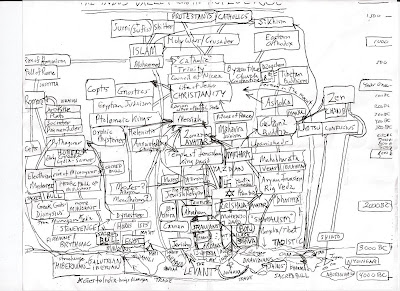
This past Tuesday (10 March 2009) the Praxivists hosted a spiritual circle discussion. At the discussion, the particpants discussed their personal spirtual experience along with what effects them spiritually. After, Mike and Anthony had another discussion with Evan Pritchard about the history of religion. During the discussion, Evan gave us a diagram about the history of religion which is attached below. You can click on the image to view it on a larer scale. I hope you enjoy it. -mike

03 March 2009
Article: Common (Liberal) Sense
Here is another article I wrote for Marist College's newspaper The Circle. It's due out on campus Thursday March 5.
Considering all the hardships this country is facing, one of America’s greatest founding fathers is becoming progressively more notable. As the government is shifting gradually towards liberalism, Tom Paine is now one of the more important ancestral figures. Paine’s importance derives from his discussions on the necessity to embrace change and to break from unnecessary and cruel tenants.
In the introduction of his pamphlet, Paine writes, “A long habit of not thinking a thing wrong, gives it a superficial appearance of being right, and raises at first a formidable outcry in defense of custom.” I think this quote applies to the current debate in Washington over economic policy. For too many years now, we have been embracing “trickle down” economic policy while deregulating important governmental welfare functions. It is time for us to stop embracing a system that we perceive to be right, and begin to embrace a system that, at first, seems to be the enemy.
I know it is difficult to break from the status quo, but we are living thorough very trying times and there is a need to try new policies. Change must come now at the first realization of wrongs. The change will break from customs, and we cannot be afraid of it. For too long this government has been allowing for the suffering of the least fortunate; individuals who have been suffering at the hands of budgets designed to benefit the wealthy.
So the “redistribution” of the nation’s wealth to benefit those who have been suffering – to provide them affordable healthcare, education, and services – is bad? Have you ever heard of the saying “we’re only as good as our weakest player?” This nation will continue to be weak if we do not help the weakest individuals in this nation. No longer should this country be the country of unregulated corporations, it is time for it to become the nation of the people.
To those who do not want to pay their share: you can afford to live comfortably while paying slightly higher taxes. It is much easier for an individual to pay more taxes if they are making a quarter of a million dollars than it is for someone who is making less than $35,000. For that, I applaud Mr. Obama. As Paine noted, “Those who want to reap the benefits of this great nation must bear the fatigue of supporting it.” In an equal and just society, every individual who is well off should bear the responsibility of helping those who are unable to support themselves.
It is time for this country to stop believing in the mantra that capitalism is always right. People in this country are suffering at this very moment because of simple issues like malnutrition and improper health care. We must now seek alternative models that will, in the end, help those who are suffering the most. With this logic, our country will improve from the bottom up, not the top down.
-mike
Considering all the hardships this country is facing, one of America’s greatest founding fathers is becoming progressively more notable. As the government is shifting gradually towards liberalism, Tom Paine is now one of the more important ancestral figures. Paine’s importance derives from his discussions on the necessity to embrace change and to break from unnecessary and cruel tenants.
In the introduction of his pamphlet, Paine writes, “A long habit of not thinking a thing wrong, gives it a superficial appearance of being right, and raises at first a formidable outcry in defense of custom.” I think this quote applies to the current debate in Washington over economic policy. For too many years now, we have been embracing “trickle down” economic policy while deregulating important governmental welfare functions. It is time for us to stop embracing a system that we perceive to be right, and begin to embrace a system that, at first, seems to be the enemy.
I know it is difficult to break from the status quo, but we are living thorough very trying times and there is a need to try new policies. Change must come now at the first realization of wrongs. The change will break from customs, and we cannot be afraid of it. For too long this government has been allowing for the suffering of the least fortunate; individuals who have been suffering at the hands of budgets designed to benefit the wealthy.
So the “redistribution” of the nation’s wealth to benefit those who have been suffering – to provide them affordable healthcare, education, and services – is bad? Have you ever heard of the saying “we’re only as good as our weakest player?” This nation will continue to be weak if we do not help the weakest individuals in this nation. No longer should this country be the country of unregulated corporations, it is time for it to become the nation of the people.
To those who do not want to pay their share: you can afford to live comfortably while paying slightly higher taxes. It is much easier for an individual to pay more taxes if they are making a quarter of a million dollars than it is for someone who is making less than $35,000. For that, I applaud Mr. Obama. As Paine noted, “Those who want to reap the benefits of this great nation must bear the fatigue of supporting it.” In an equal and just society, every individual who is well off should bear the responsibility of helping those who are unable to support themselves.
It is time for this country to stop believing in the mantra that capitalism is always right. People in this country are suffering at this very moment because of simple issues like malnutrition and improper health care. We must now seek alternative models that will, in the end, help those who are suffering the most. With this logic, our country will improve from the bottom up, not the top down.
-mike
26 February 2009
MadLib: Praxivist Warrior
Anthony, Sam, and Mike did this MadLib about their praxivist friend Jaimee who is studying abroad this semester. All the additions are in green!...
Jaimee DePompeo is no joke, a praxivist warrior. When her consciousness became aware about Food Not Bombs she fasted for four-hundred and twelve trillion days. She arised compassion in many others, and even became skinnier than Gandhi did. When Docter Mar showed her a short about Thoreau she became graciously inspired. So much so, that she dumpster-dived an elephant sized wood just so she could spread the message “Resist Mc-Domination!” all over this land. Change manifested. It blossomed like a sun flower. Separate became unity. Beauty in her, radiated outward, and happily ever after, liberated in laughter, THE ENTIRE KINGDOM CREATURE COMMUNITY. So next time you see this prophet in person, give her a hug or a high-ten. Heighten and enlighten. All right then!
Peace
-Anthony
-Mike
-Sam
Jaimee DePompeo is no joke, a praxivist warrior. When her consciousness became aware about Food Not Bombs she fasted for four-hundred and twelve trillion days. She arised compassion in many others, and even became skinnier than Gandhi did. When Docter Mar showed her a short about Thoreau she became graciously inspired. So much so, that she dumpster-dived an elephant sized wood just so she could spread the message “Resist Mc-Domination!” all over this land. Change manifested. It blossomed like a sun flower. Separate became unity. Beauty in her, radiated outward, and happily ever after, liberated in laughter, THE ENTIRE KINGDOM CREATURE COMMUNITY. So next time you see this prophet in person, give her a hug or a high-ten. Heighten and enlighten. All right then!
Peace
-Anthony
-Mike
-Sam
24 February 2009
Article: The new wave of Liberalism
This is an article I wrote for Marist College's newspaper The Circle and is due out on campus Thursday February 26. Enjoy...
With all the ideological struggle in America over the alleged culture war, it seems natural for there to be massive backlash by the political right in response to the changes Mr. Obama is attempting to push through in Washington. But the change from conservatism to liberalism is nothing new, particularly in American politics. What we may see now, though, is a general shift in public opinion and governmental policy that will reflect a more liberal model.
It isn’t too much out of the ordinary to see minor sways in the government’s policy nor is it uncommon to see slight changes in public opinion over the course of 20 years or so. What is major is seeing a complete realignment of public opinion to another ideology. This type of massive shift is usually a result of massive social and political unrest. We saw this with the election of Roosevelt in 1932 and the election of Reagan in 1980, the public changed their political alignment towards another political view based on economic hardship.
Now we are confronted with a new scenario: was the election of Obama a response against the conservative America built by Reagan, Gingrich, and the Bushes? This is a possibility. It seems as though the voting public dramatically swayed towards liberalism and, in doing so, gave the Democrats a mandate to try out their policy. Pundits have been noting that it seems as though America is fed up with the conservative economic and foreign policy of the previous administrations including Clinton.
The issue now is to what extent is the government going to liberalize. I find it hard to believe that the government will sway as drastically left as conservative pundits are speculating. Although the conservatives are worried about the extent to which the government will liberalize, they must allow Obama to try out his policies to try and better America
It is time for welfare reforms, to increase funding into education, and to mend one of the most tattered healthcare systems in the industrialized world. Who knows? We may even catch up to Europe in our quality of healthcare. We may even catch up to Cuba!
The conservatives have had their opportunity to lead the country, they have been doing so for the last 28 years. Now it is liberals turn to try and run the country with their policies. Trends dictate that within the next 20 years – if Obama succeeds in leading the new liberal movement – there will be a transition back to conservative politics.
I would like to close this article with a quote from conservative columnist Bill Kristol: “Liberalism’s fate rests to an astonishing degree on Obama’s shoulders. If he governs successfully, we’re in a new political era.”
-mike
With all the ideological struggle in America over the alleged culture war, it seems natural for there to be massive backlash by the political right in response to the changes Mr. Obama is attempting to push through in Washington. But the change from conservatism to liberalism is nothing new, particularly in American politics. What we may see now, though, is a general shift in public opinion and governmental policy that will reflect a more liberal model.
It isn’t too much out of the ordinary to see minor sways in the government’s policy nor is it uncommon to see slight changes in public opinion over the course of 20 years or so. What is major is seeing a complete realignment of public opinion to another ideology. This type of massive shift is usually a result of massive social and political unrest. We saw this with the election of Roosevelt in 1932 and the election of Reagan in 1980, the public changed their political alignment towards another political view based on economic hardship.
Now we are confronted with a new scenario: was the election of Obama a response against the conservative America built by Reagan, Gingrich, and the Bushes? This is a possibility. It seems as though the voting public dramatically swayed towards liberalism and, in doing so, gave the Democrats a mandate to try out their policy. Pundits have been noting that it seems as though America is fed up with the conservative economic and foreign policy of the previous administrations including Clinton.
The issue now is to what extent is the government going to liberalize. I find it hard to believe that the government will sway as drastically left as conservative pundits are speculating. Although the conservatives are worried about the extent to which the government will liberalize, they must allow Obama to try out his policies to try and better America
It is time for welfare reforms, to increase funding into education, and to mend one of the most tattered healthcare systems in the industrialized world. Who knows? We may even catch up to Europe in our quality of healthcare. We may even catch up to Cuba!
The conservatives have had their opportunity to lead the country, they have been doing so for the last 28 years. Now it is liberals turn to try and run the country with their policies. Trends dictate that within the next 20 years – if Obama succeeds in leading the new liberal movement – there will be a transition back to conservative politics.
I would like to close this article with a quote from conservative columnist Bill Kristol: “Liberalism’s fate rests to an astonishing degree on Obama’s shoulders. If he governs successfully, we’re in a new political era.”
-mike
18 February 2009
Poem: Observations through glass
Looking into the world through the
Safety of glass encasement allows one
To see the world as it is, unbridled
From the worst and simplistic as to
Only view motion.
I see (a):
Woman running, sleek and slender moving
Easily as each step allows for another
Spring forward.
Friends walking along a path moving toward
A shared destiny as each step brings
Them closer to me, or further away?
Trees gently rustling in the breeze
Swayed by nothing more than nature
Existing, for no purpose?
River gently flowing pushing along its
Contents without purpose propelled by
Nature’s currents.
Snow dripping away into the soil without
Concern to what it has been or where
It is going or what affect it has.
The observations show me that
Things change naturally with fluidity
And foster positive outcome. Things
Created by sudden occurrences are formed
From malice and the unintentional and are
Not meant to be emulated.
Change comes with
Ease and Peace.
-mike


Safety of glass encasement allows one
To see the world as it is, unbridled
From the worst and simplistic as to
Only view motion.
I see (a):
Woman running, sleek and slender moving
Easily as each step allows for another
Spring forward.
Friends walking along a path moving toward
A shared destiny as each step brings
Them closer to me, or further away?
Trees gently rustling in the breeze
Swayed by nothing more than nature
Existing, for no purpose?
River gently flowing pushing along its
Contents without purpose propelled by
Nature’s currents.
Snow dripping away into the soil without
Concern to what it has been or where
It is going or what affect it has.
The observations show me that
Things change naturally with fluidity
And foster positive outcome. Things
Created by sudden occurrences are formed
From malice and the unintentional and are
Not meant to be emulated.
Change comes with
Ease and Peace.
-mike


10 February 2009
Poem: energy, flow

Solitude in wisdom, energy in flow.
We are the observers of the flow
Bearing witness to the constant
Moving of the people wrought by
Time and forced into observance.
We know not what we see for
Believing what is unknown is the
Folly of the believer and the
Knowledge of the thinker is to
Know that nothing is definite and
That finite particles can mean the
World or nothing at all.
We are the keepers of the gate,
Those who allow energy to
Flow and the guardians of what
May seem right but only truly
Express self-interest and offer
Nothing but the gentle rise of
Personal ego letting wind to the
Fruitless nature of passionless action.
We are all part of one, cog wheels in
The motion of life ticking in unison to
Strive for what ought to be and to
Berid this planet of what shouldn't;
That which is unfortunate was never a
Friend of us but we need not hold
Disdain towards things, objects that we
Cannot necessarily control as they are
Meant to be, meant to be wrong?
Nothing is inherently wrong, simply
Misguided by negative principals or
Strung about by mantra and partisanship.
We must accept the word of another to
Realize that we are truly citizens on a
Ship, a vessel known as a planet, the
Celestial body that we hold and too often
Ruin out of greed and want and other
Misguided principals.
It is our obligation to right that
Has become wrong and to strive for
A better planet to inhabit, to
Advocate for the truly ideal, to
Become Citizens.
-mike
note: the picture before this poem was taken by me while I was in South Africa in the countryside an few hours outside of Durban.
31 January 2009
Poem: The Quick Story of the World
A man’s death diminishes me,
Because I am involved in mankind;
And therefore never send to know
For whom the bell tolls;
It tolls for thee. -John Donne
Third world’s dying while
Second world’s crawling while
First world’s gunning
And running.
Force leads to profit,
Profit leads to wealth,
Wealth leads to greed,
Greed leads to corruption,
Corruption runs the world.
First world’s gunning
Third world’s running
Nowhere to hide
Second world’s in limbo.
It is a story well known by those who wallow:
Inconsideration, ignorance, misunderstanding
Perhaps?
NO.
It is the intention of the crat with his
Rat-a-tat-tat spoke scratchin at the back
Of those who wallow in their ghettos
Forced by those who care little of humanity
But would rather see a profit increase one
Half a percent stuck in place cause
There is no place for the other half,
Quarter, whole, they don’t care, they
Can change it all but they let them
Live in des pair; they push arms and
Take leg’s, rape minds, and pillage the
Most precious resource of them all,
Hope, dignity, promise, potential
Perhaps?
NO.
They went the way of the WTO and
Legalized the selling of people for profit
Because tis easier to own one’s workers
Rather than treat them like an equal
A brother, a friend, an acquaintance
A human.
There is no room for humanity in the
Marbled walls of the world’s headquarters
Because, after all, they must know what is
Best, after all, they do have all the money.
So because of this false sense of authority
[authority being perceived dominance over
Another human that is in every sense of the
Word equal to him or her or it. Bullocks]
They exploit the resources, people and
LIVES of those who were just unlucky enough
To be born outside of the “industrialized” world.
They care less about the fellowship of man
And more of their all mighty god
The all mighty Dollar.
The one that justifies murder hate, violence.
The one that fosters destruction, malice, ignorance.
The one that causes misery, pain, woe.
The one that we all praise.
And therefore
The world dies.
And do not send for me
For I already know:
The bell has tolled
It tolls for thee.
Enjoy the thought food
Power to the Peaceful!
-mike
Because I am involved in mankind;
And therefore never send to know
For whom the bell tolls;
It tolls for thee. -John Donne
Third world’s dying while
Second world’s crawling while
First world’s gunning
And running.
Force leads to profit,
Profit leads to wealth,
Wealth leads to greed,
Greed leads to corruption,
Corruption runs the world.
First world’s gunning
Third world’s running
Nowhere to hide
Second world’s in limbo.
It is a story well known by those who wallow:
Inconsideration, ignorance, misunderstanding
Perhaps?
NO.
It is the intention of the crat with his
Rat-a-tat-tat spoke scratchin at the back
Of those who wallow in their ghettos
Forced by those who care little of humanity
But would rather see a profit increase one
Half a percent stuck in place cause
There is no place for the other half,
Quarter, whole, they don’t care, they
Can change it all but they let them
Live in des pair; they push arms and
Take leg’s, rape minds, and pillage the
Most precious resource of them all,
Hope, dignity, promise, potential
Perhaps?
NO.
They went the way of the WTO and
Legalized the selling of people for profit
Because tis easier to own one’s workers
Rather than treat them like an equal
A brother, a friend, an acquaintance
A human.
There is no room for humanity in the
Marbled walls of the world’s headquarters
Because, after all, they must know what is
Best, after all, they do have all the money.
So because of this false sense of authority
[authority being perceived dominance over
Another human that is in every sense of the
Word equal to him or her or it. Bullocks]
They exploit the resources, people and
LIVES of those who were just unlucky enough
To be born outside of the “industrialized” world.
They care less about the fellowship of man
And more of their all mighty god
The all mighty Dollar.
The one that justifies murder hate, violence.
The one that fosters destruction, malice, ignorance.
The one that causes misery, pain, woe.
The one that we all praise.
And therefore
The world dies.
And do not send for me
For I already know:
The bell has tolled
It tolls for thee.
Enjoy the thought food
Power to the Peaceful!
-mike
Drawing: Humanize

Although this may be a simple doodle I thought up while I was being berated with conservative business theory in economics, I think its message is simple enough and powerful enough to stand on its own.
Power to the peaceful!
-mike
30 January 2009
8 Years Gone
We are eight years
Gone from the wreck.
It is odd to see all
That once was is
Now Gone.
The pain I had on
My face that day is
Hard to think of.
Why did they rule
The way they did?
Why did they
Force change on us?
It is not in my mind
Now, it is gone.
The hurt I, NAY we,
Felt then is now gone.
I still do not know how
All this came to be.
I find that I am still
A bit in shock.
But that ship is at
Sea, and I will not see it.
Why did the court
Rule that way in
Bush v Gore?
That was a poem I wrote in my grammar, style, and editing class during an exercise where we had to write a passage using only one syllable words.
Enjoy the thought food
Power to the peaceful!
-mike
Gone from the wreck.
It is odd to see all
That once was is
Now Gone.
The pain I had on
My face that day is
Hard to think of.
Why did they rule
The way they did?
Why did they
Force change on us?
It is not in my mind
Now, it is gone.
The hurt I, NAY we,
Felt then is now gone.
I still do not know how
All this came to be.
I find that I am still
A bit in shock.
But that ship is at
Sea, and I will not see it.
Why did the court
Rule that way in
Bush v Gore?
That was a poem I wrote in my grammar, style, and editing class during an exercise where we had to write a passage using only one syllable words.
Enjoy the thought food
Power to the peaceful!
-mike
Subscribe to:
Posts (Atom)